The face of the moon was in shadow
Overview
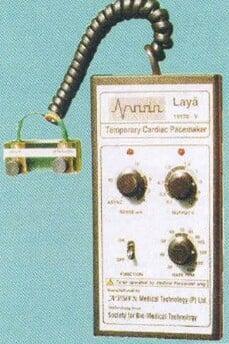
The External Cardiac Pacemaker project represents one of SBMT's most complete end-to-end success stories in indigenous medical device development. Beginning as a research initiative to serve patients with degenerative heart disease, it resulted in two fully functional pacemaker devices — a programmable external pacemaker for intensive care use and a programmable implantable pacemaker — both developed, validated, and ultimately transferred to Indian industry for commercial production.
The commercialised product, named LAYA, was brought to market by M/s. Apson Technologies, Bangalore, at a price of ₹30,000 per unit — making it one of the most affordable pacemakers available in India at the time.
The Clinical Need
Degenerative heart disease can impair the heart's natural electrical conduction system — the mechanism that regulates the timing and rhythm of each heartbeat. When this system fails or becomes unreliable, the heart may beat too slowly, too irregularly, or not at all. Left untreated, the consequences are severe and potentially fatal.
A cardiac pacemaker addresses this directly. It delivers precisely timed electrical impulses to the heart muscle, restoring a safe and regular rhythm. For patients in acute care settings, an external pacemaker provides immediate, adjustable pacing from outside the body. For patients requiring long-term management, an implantable pacemaker performs the same function from within — permanently and unobtrusively.
Both categories of patients existed in large numbers across India. Both were being served almost exclusively by imported devices at prices far beyond the reach of most families.
Development
The sensing and pacing software at the heart of both devices was developed at Research Centre Imarat (RCI), Hyderabad — a defence research institution under DRDO — in collaboration with SBMT. RCI's expertise in precision electronics and embedded systems made it a natural partner for a device that demands extraordinary reliability in the most critical of clinical environments.
The project delivered two distinct products:
- Programmable External Pacemaker Designed for use in intensive care settings, this device allows clinicians to set and adjust pacing parameters — rate, output, sensitivity — non-invasively from outside the body. It is used in acute cardiac events, post-operative care, and as a bridge to permanent pacing, giving the clinical team precise control over the patient's cardiac rhythm during a critical period.
- Programmable Implantable Pacemaker Designed for patients requiring permanent pacing support, this device is surgically implanted and programmed to deliver electrical stimulation automatically whenever the heart's natural rhythm falls below the prescribed threshold. Its programmability allows cardiologists to fine-tune its behaviour after implantation — without further surgery — adapting to the patient's changing needs over time.
Clinical Validation
Both devices underwent rigorous clinical trials following development. The trials returned satisfactory results across all key parameters, confirming that the sensing and pacing performance of the indigenous devices met the clinical standards expected of pacemaker technology.
Validation was conducted in partnership with medical institutions equipped to assess the devices under real-world conditions — a process that gave clinicians, regulators, and ultimately patients the confidence that LAYA was a safe and effective alternative to imported pacemakers.
Technology Transfer and Commercialization
Following successful development and clinical validation, SBMT transferred the technology to M/s. Apson Technologies, Bangalore — an Indian medical device company positioned to manufacture and distribute the pacemaker at scale.
The commercialized product was launched under the name LAYA and priced at ₹30,000 per unit. At a time when imported pacemakers commanded prices many times higher, this represented a transformative reduction in cost — placing a life-sustaining cardiac device within the financial reach of a far broader segment of the Indian population.
The technology transfer model itself was significant: it demonstrated that defence and biomedical research institutions could not only develop medical devices to clinical standard but successfully hand them off to the private sector for sustainable, long-term production and distribution.
Impact
LAYA's impact extended across three dimensions. For individual patients, it meant access to a device that could regulate their heartbeat and sustain their quality of life — at a price their families could afford. For the Indian healthcare system, it meant reduced dependence on imported pacemaker technology and the associated foreign exchange burden. And for the ecosystem of biomedical innovation in India, it demonstrated that the full pipeline — from research and development through clinical validation to commercial launch — could be executed indigenously, end to end.
Legacy
The External Cardiac Pacemaker project stands as a model of what coordinated indigenous medical device development can achieve. The involvement of a defence research institution (RCI, Hyderabad), a biomedical technology society (SBMT), and a private industry partner (Apson Technologies) created a collaboration that moved from laboratory to clinic to market — serving patients who needed it most.
LAYA remains part of SBMT's proud legacy of innovations that placed Indian patients and Indian capability at the centre of healthcare progress.
The External Cardiac Pacemaker (LAYA) is part of SBMT's historic portfolio of indigenous biomedical innovations. For more information, contact us at contact@sbmtindia.org.